“Leaders who don’t listen will eventually be surrounded by people who have nothing to say”.
(Andy Stanley)
So, need to vent for a minute.
Continue to see and hear across multiple industries where the boss makes job description modifications (additions/deletions/unit changes) without discussing with the person doing the actual job. The boss is then surprised when staff decide to find a work environment that views them as more than the job description.
Please note, I’m not saying changes can’t be made to a specific job description. Organizational missions change and updating duties, responsibilities and unit structure provides growth needed to move forward. Leaders need to ensure the people tasked with getting things accomplished remain a part of the overall process. Imagine the favorite part of your current position is removed and nothing was said to you prior to implementation. How would you feel?
I know leaders who make decisions based on how the job description is written and refuse to consider the impact on the person in the position. Never agreed with this logic and still don’t. People are more important than the job description!
The authentic leadership variable balanced processing would help in these situations. My research identified balanced processing as the variable that best explains job satisfaction for direct reports. They want to be involved and should be.
Leaders are encouraged to seek and find the big picture before making decisions. Simply identifying potential job description changes would allow staff to provide input before the final product is created. Balanced processing is leveraged to build trust, encourage professional growth for direct reports and provides a foundational and reliable decision-making process. It also signals all opinions are valued and expected. The concept eliminates personal bias from the decision-making process, everyone in the organization has input prior to the final decision. Again,people are more important than the job description!
I continue to promote the authentic leadership model because it can help create positive workplace outcomes and improve organizational performance. It may also stop workplace turnover and get me off this overworked soapbox!
Okay, I’m dropping the microphone and stepping down from my soapbox. 😊
How does your work environment ensure people are not overlooked? Does your leadership put job descriptions ahead of the people doing the job? (Please respond in the comments section below—thanks!)
“It is trust that transforms a group of people into a team”.
“On the other side of your maximum fear are all the best things in life”.
(Will Smith)
How many times have you talked yourself out of doing something based on perceived fears? I’m talking about larger life episodes like changing careers, starting your own business, learning a new skill or traveling to an exotic locale.
Sometimes we fear the unknown simply because it is unknown. Nothing has happened to instill the fear we live with; we just bring it along into our daily routines. Don’t let that little voice in your head talk you out of pursuing something you want to accomplish. Positive thoughts generate positive outcomes! Tackle life with an Irie mindset!
Look for ways to embrace your fear and understand the root cause. Challenges provide opportunities to grow so don’t let a little apprehension stop you from making a move. Try to place a marker or name on what you fear. Is it the actual change, lack of confidence, professional requirements or something else? Understanding the root cause of fear provides a road map to help overcome the thing you fear—sounds simple, right?
Look for ways to visualize the successful outcome you seek. Leverage a vision mapping process to walk you through the entire process. Start with the most basic concepts and then work to put everything into a step-by-step diagram as a road map for success. Your vision map may show holes in your thought and execution patterns you can counter to help eliminate fear and enable success. The vision map also allows you to put time frames in-place to accomplish the task you identify.
Positive people make positive things happen! I continue to stress having an Irie mindset. Believe this is vital daily in life. Expect great things to happen and back up the expectations with proactive research, conversations and efforts needed to get what you want. Positive thoughts will help build up resiliency so when faced with obstacles you go to the next option but never stop trying to get what you want.
Be prepared to pivot as needed. There are times a fundamental change in approach is needed to get what you want. This is not a failure but a proactive way to work towards outcomes to enhance your current situation. Do you need to get a specific certification prior to starting a career change? Do you need to have a business partner to make your small business idea successful? The willingness to pivot when needed can eliminate a level of fear associated with similar changes.
“Staying positive does not mean that things will turn out okay. Rather it is knowing that you will be okay no matter how things turn out”.
(Unknown)
Accept fear as a natural motivator in life. Sounds counterproductive but what if you tackle a small fear daily to build up confidence for the larger things in life? Fear public speaking? Then join Toast Masters to get in front of people to learn how to overcome this fear. I’m a natural introvert so speaking in front of people was a fear I had. Discovered the more I speak in front of groups the less fear I have. The process becomes easier the more I face the fear.
Mentors can help you when facing your fears. We should all have multiple mentors to help get through personal and professional scenarios. Why not enlist a mentor when you must face a fear? This trusted advisor may have experience in the area and can provide insight to help you move forward. The mentor can also serve as a sounding board for you to present your thoughts. This simple concept may allow you to hear what’s holding you back. Your mentor will be able to provide feedback based on thoughts you present as well.
Fears are natural to most of us. Visualize success, leverage positive thoughts, pivot if needed, accept fear to defeat it and engage your mentors. Simple, huh? 😊
Remember, everything Irie!
What tools do you leverage to overcome fear? What have you thought about doing but let fear hold you back? (Respond in the comments section—thanks!)
“If you want to go fast, go alone. If you want to go far, go together”.
(African Proverb)
My collective tree branches continue to amaze me daily!
I enjoy watching the great things they are doing in their respective areas of higher education, mentoring, volunteering, speaking, podcasting, recruiting, leadership development and fitness to name a ‘few’ areas these outstanding folks are making a difference.
The one area that stands out to me today as I write this is the teamwork they constantly display. My Walk into the Future has led me away from a physical office space—as noted, I primarily work out of coffee shops with Lucky Goat being first choice. My previous work life allowed me to be surrounded by direct reports and colleagues every day. There was always someone available to me whenever I had a question, concern or marketing idea I needed to hash out.
“If everyone is moving forward together, then success takes care of itself”.
(Henry Ford)
My current walk provides me unlimited freedoms to decide what I work on and when. The one limiting factor is I don’t have ‘my’ team right down the hallway to bounce things off.
A great aspect of having so many tree branches is they are only a text message, email or phone call away when I need help. Today was a perfect example of how great my tree branches are. Needed some help generating a Presentation Value Proposition for a conference proposal I was working on.
I had no trouble describing my proposed presentation, highlighting learning outcomes and generating an overall summary. Couldn’t generate the Value Proposition for the presentation for some odd reason—just couldn’t make it pop or even sound interesting.
Reached out to two of my most creative tree branches and described my dilemma. Provided them with what I needed to do and my attempt to generate the Value Proposition. They both jumped into teammate mode and sent me back appealing options for the Value Proposition that made the presentation sound exciting. The point being is even without us being in the same cities, my team still has my back and we make each other better daily.
The ability to stress the importance of teamwork is something I’m proud to bring to every organization I’ve worked with. It’s great to see my tree branches continue to embrace team concepts and help others grow. Well done tree branches—keep up the great things you do daily! Very proud of your efforts!
Thanks to my tree branches who return my texts, emails, phone calls and LinkedIn shout outs! You’re fueling this journey one step at a time—Irie!
What are the most important team concepts you display daily? How can you enhance the team experience in your work environment? Thanks!
Respect Melissa and V’Rhaniku!
(2016 team bowling outing)
“If you want to lift yourself up, lift up someone else”.
“You have to apply yourself each day to becoming a little better. By becoming a little better every day, over a period of time, you will become a lot better”.
(John Wooden)
Growth mindset has been defined as people believe their most basic abilities can be developed through dedication and hard work—brains and talent are just the starting point (Carol Dweck).
Fixed mindset
A fixed mindset puts undue parameters in place. An individual who believes they are only good at certain things will most likely only be good at those things. You can talk yourself into or out of anything. A fixed mindset can hinder progress because of the avoidance of anything that may challenge you. This process causes individuals to give up when tasks get hard or unfamiliar.
A fixed mindset limits individual growth because of sticking to what you know only—attempts to try or learn new things are avoided at all costs. A sad aspect of this mindset is when people believe potential is predetermined.
“Whether you think you can or think you can’t—you’re right”.
Contrasting the fixed mindset with growth mindset highlights the importance of positive thinking and actions. People with a growth mindset view failure as an opportunity, not something to shy away from. Functioning as a lifelong learner is another aspect of the growth mindset—the foundational principle is to never stop learning new things and tasks.
Positive effort and attitude are thought to be determining factors toward individual abilities. This concept helps eliminate being defeated even before starting a task. The success of others leads to inspiration for someone with a growth mindset.
The great things my tree branches accomplish daily inspire me to continue to grow and make a difference.
A hidden aspect of the growth mindset is the freedom it provides to practitioners.
Growth mindset is based on not limiting yourself (thoughts or actions) so you approach each day as a gift. You seek new challenges because you have the tools to accomplish them. You’re willing to try new things because you never want to stop learning and improving your knowledge and abilities. Setbacks are your opportunity to learn, reset and then try another approach to the challenge you face.
Lessons are everywhere when you embrace the growth mindset.
“Whatever the mind of man can conceive and believe, it can achieve.”
(Napoleon Hill)
Growth mindset key factors:
You can learn anything needed for success
Displaying the right attitude makes learning possible
Challenges are viewed with excitement
Failure is not the end
Positive words, thoughts and actions daily
“It does not matter how slowly you go so long as you don’t stop”.
(Confucius)
How can a growth mindset impact your daily interactions? What things do you need to change to adopt a growth mindset? Thanks!
“You have to motivate yourself with challenges. That’s how you know you’re still alive”.
(Jerry Seinfeld)
I’m always looking for ways to expand my knowledge base to help me with my Walk into the Future.
Networking and partnering with individuals and organizations has been fruitful in 2019. The Greater Orlando Organizational Development (GOOD) network was recommended to me by a tree branch as an organization with consultants/practitioners with similar interests as me.
The GOOD network has been great so far especially with networking platforms they currently promote. They have monthly professional development workshops to bring members together to share and learn from others. This process enabled me to get involved with organizations to see what they do, learn from veterans in the career field and share my knowledge and experiences with them. Felt good (no pun intended) to share my authentic leadership platform research with practitioners who were looking for ways to engage leaders in their respective organizations with evidence-based research.
Made several professional contacts with aspirations to leverage into additional research and application of authentic leadership in business environments. My initial research was done within a university setting but believe we can easily translate the four variables (self-awareness, relational transparency, internalized moral perspective and balanced processing) into multiple work environments to enhance leadership development and job satisfaction for direct reports.
Currently working on a proposal to present at the First Annual Organizational Development (OD) Conference, Ignite Your Future: Innovation in Action in February 2020. Plan to bring my authentic leadership research to the conference to enhance audience understanding on the leadership platform and how it can be used to provide leaders with tools to enhance their work environment. Excited for the opportunity to stand in front of movers and shakers of some of the largest organizations in Orlando and show them the value of authentic leadership.
Excited and scared at the same time but my walk continues to move forward!
This process may provide me with additional tree branches as I continue my quest to enlarge my tree. Wish me luck!
What have you done lately to move from your comfort zone? How do you challenge yourself to try new things professionally? I welcome your thoughts—thanks!
“I don’t run to add days to my life, I run to add life to my days”.
(Ronald Rook)
Decided early to make my Walk into the Future about setting goals and then putting in the work to meet those goals. Very proud of my efforts so far in 2019 as I continue to cross things off my list daily. One of my ongoing 2019 goals is to run a half marathon under 2 hours. I’ve improved my best time twice this year for a total of 5 minutes faster than I ran in 2018. My best time of 2:08:21 (2 hours, 8 minutes, 21 seconds) was run at the 2019 Nashville Rock n Roll Half Marathon back in April. Very proud of this time and training used to get ready for Nashville. Again, my 2019 goal is to run under two hours, so still have work to do.
Miles, miles and more miles
Determined the best way to run faster was to increase my training program with additional miles. I had to put some thought into how this would happen considering I would be running during the summer in Florida. The heat and humidity can be unbearable just walking around so running would be an additional challenge. Set my running schedule to avoid the hottest times during the day—early morning runs allowed me to get out and back before the full heat and humidity of the day kicked in. Weekend runs started a bit earlier since I leveraged this time for my long runs. Learned quickly getting out and back before 9:30 am was ideal—anything past 9:30 am and the heat beats you up.
Logged 50+ miles in June using this training method. June also provided me with the blueprint on times to run, times to avoid and how to hydrate properly to pull this process off successfully. Increased my training miles in July to 70+ by running two weekday runs of 5 – 6 miles each and then having a long run of 8 – 10 miles on the weekends. Also, started carrying a hydration belt with Gatorade and water so I could replenish fluids while out for my run. Hydration belts are not the coolest looking accessory, but it is very functional when you need something to drink miles away from water.
I extended my training program and physical capabilities in August with a 100+ mile month. My two weekday runs were extended up to 8 miles each and my weekend runs extended up to 11 – 12 miles. My longest August training run was 12.65 miles. Long runs were done to get the miles in, didn’t try to hit race pace since I wanted to build up my running base without trying to hit a specific time. Ironically, my long run times were still better than some half marathons I ran a few years ago. Looks like I’m getting faster just by adding long runs to my training program.
Note: I still made it to the gym for my normal workouts and extra cardio. Running was the priority for run days, but I didn’t eliminate weight training, yoga or stretching sessions.
September is my taper month as I refresh my legs for the Philadelphia Rock N Roll Half Marathon on 9/15/19. I logged 20 running miles in September to complete my training program prior to heading off to Philly. This allowed me to mentally and physically get ready to run my best in Philly.
The best part of being this close to a race is I get to carb load—all the pasta and bread I want! 😊 This will help my energy levels during the race and keep me moving fast.
Mixed in hills, intervals and long runs into my training program prior to Philly. Felt I needed to incorporate more hills and intervals after my Nashville race. Believe these added programs will give me the endurance, speed and mental toughness needed to get under two hours in Philly. We will see! If not, the next race is 10/26/19 in Boston, Georgia.
You can follow my Philly progress using the Rock N Roll app:
Always wonder if my leadership and mentor quotes travel well.
Received the image above a couple weeks ago from a Career Center friend in South Florida. The Career Center had Graduate Assistants (GAs) present to leadership how they would incorporate National Association of Colleges and Employers (NACE) competencies into daily interactions with students and alumni.
One of their GAs researched the NACE site and found an Authentic Leadership article done with me and leveraged my words to make her point on how a leader truly inspires an organization. I was happy to see my words helping the next generation of college students and future leaders.
So, yes, proud to say people are listening and putting these words into action! 😊
I continue to promote Authentic Leadership as a platform to enhance organizational success. The four variables are easy to understand and apply in daily interactions within the work environment. True leaders need to be visible and available to engage direct reports to ensure everyone has input in how the organization operates. Top down leadership may be needed in isolated situations, but your people want to be engaged. The only way to accomplish this is to engage them—simple concept.
Leverage Napoleon’s words above and become a dealer of hope.
What’s your favorite leadership quote? How does the quote impact your daily interactions? I welcome your thoughts, thanks!
“As we look ahead into the next century, leaders will be those who empower others”.
‘Good teams incorporate teamwork into their culture, creating the building blocks for success.’
(Ted Sundquist)
The 1992 United States men’s Olympic basketball team was nicknamed the Dream Team because of the collection of NBA superstars who made up the team’s roster. The roster included Michael Jordan, Scottie Pippen, Larry Bird, Magic Johnson and Charles Barkley to name a few players. Every member of the Dream Team was considered the top player(s) on their respective NBA team—the best of the best.
So, with a collection of overwhelming talent available on the Dream Team, this roster is considered the greatest basketball talent ever assembled on one team. With that in mind, do you know what their ‘overall’ record was? Most people will say the Dream Team was undefeated in their run towards Olympic gold in 1992. The Dream Team’s overall record was: 8 – 1. That’s right, the greatest collection of individual basketball talent lost a game in their quest for Olympic gold.
Head coach Chuck Daly assembled a collection of college basketball stars to scrimmage the Dream Team to help prepare for the style of play they would encounter in the Olympics. College stars Grant Hill, Penny Hardaway, Chris Webber and others were invited to training camp to match up with their basketball idols. The Dream Team lost to their understudies on June 24, 1992, 62-54 because they assumed, they would roll through the college kids.
The Dream Team hadn’t completely bought into the ‘team’ concept because they were all great individual players and thought they would overwhelm any team put in front of them. To be fair, coach Chuck Daly limited Michael Jordan’s minutes and didn’t utilize his players to optimize their playing time. This strategy was taken to get the pros to focus and understand they could be beaten without ideal situations. The next time the Dream Team played the same collection of college players, they beat them soundly.
The Dream Team provides an excellent example of how team building enhances organizational success. Simply hiring people and then telling them they are a team does not work. Understanding team members’ strength, weaknesses and communication styles are a few things needed to build and enhance team dynamics.
Myers-Briggs Type Indicator (MBTI)
The MBTI is a self-report tool that provides and makes psychological types as described by C. G. Jung understandable and useful (MBTI). Organizations use the MBTI for various in-house needs. One area I have found useful for the MBTI is for team communication. I have direct reports complete the MBTI and then create an organizational chart we share with the team, so everyone knows the MBTI for their teammates. We create desktop placards or MBTI heads to display in individual offices as a quick reminder of everyone’s MBTI.
I leverage this knowledge when assigning tasks to team members. There are MBTIs who crave fast-paced and deadline filled assignments and others who view these type things as torture. The key is balancing assignments to maximize the team and help individuals grow. So, I’m not saying an introvert never has to do presentations but understanding team members helps with the overall health of an organization.
Understanding MBTIs within a team construct has led team members to appreciate each other more. My MBTI is ISTJ and if you view the MBTI head associated with me you discover things like analytical, organized, and calm. This knowledge helps everyone on my team understand why a perceived crisis does not impact me the same way it would someone who is an ENFP. No MBTI is perfect but understanding other indicators provides a team with a foundation to grow. This growth is a starting point for open communication and a successful team.
CliftonStrengths
I was introduced to CliftonStrengths (formerly StrengthFinders) during my time at the University of Central Florida Career Center. We were looking for ways to maximize our team and contracted to have someone come in to facilitate a workshop for the organization. This was an eye-opening experience for staff. I discovered my Talents were: Analytical, Relator, Learner, Deliberative and Strategic.
This knowledge will allow leaders and teams to build on current talents in the organization. I can leverage my identified talents with someone who has more talent in another area to ensure the team can complete a task. This can only be done ‘if’ talents are identified in advance.
There are other tools available to help leaders build teamwork and communication strategies for an organization. The MBTI and CliftonStrengths are two I have used and provided multiple organizations with outstanding results.
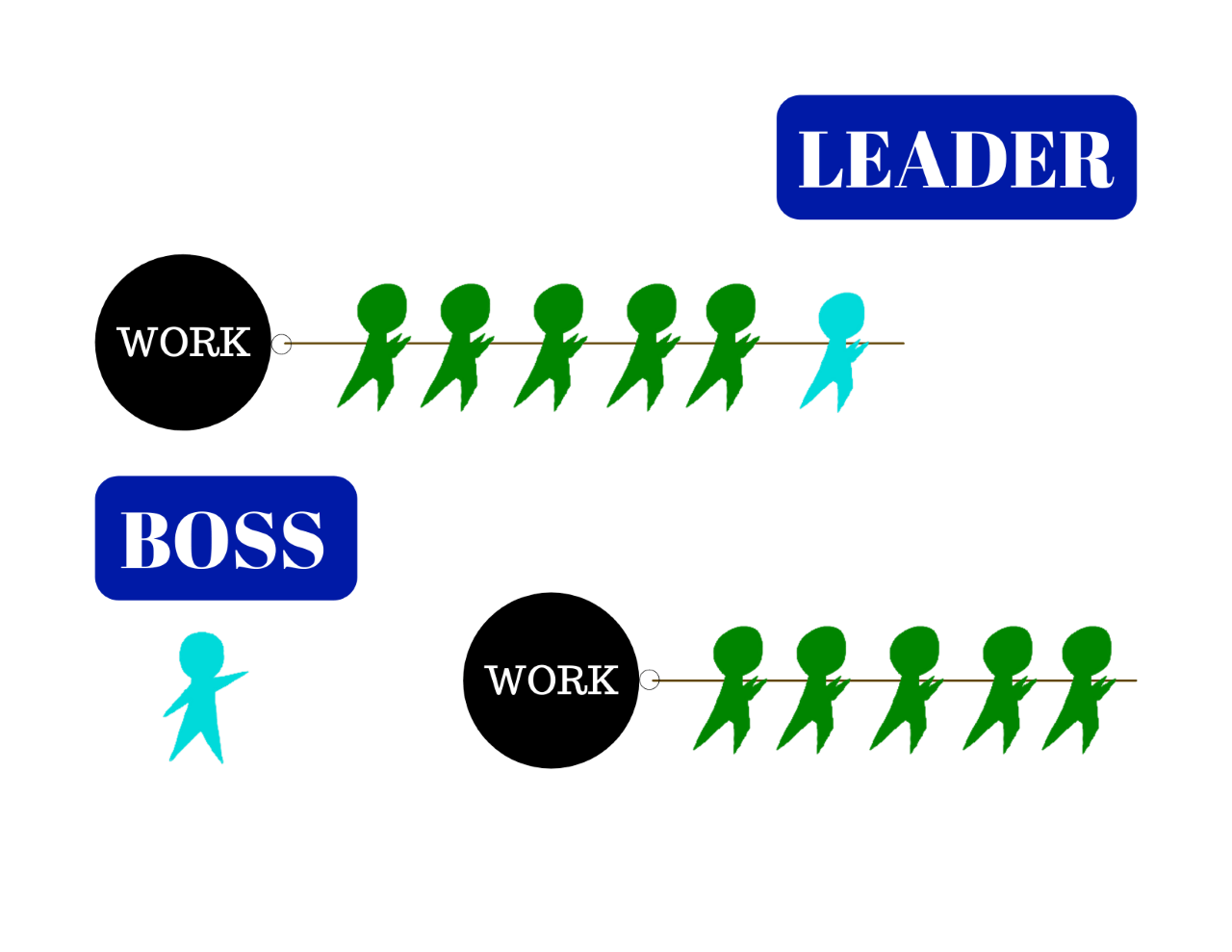
I love the image above for the simple message it sends. True leaders are not afraid to engage to ensure team success. Leaders display a level of humility when they show direct reports they are a part of the overall team, not just the person demanding results.
Contrast the two examples in the image. Who would you want to work for? The leader or the boss? Why?
I have been lucky to work for some truly great leaders in multiple work environments. They all shared a vision of what success looks like and made sure everyone was working toward the same goals. These great leaders always led by example and made professional development/learning a priority in the workplace. This enhanced direct report engagement and made everyone want to get more accomplished. Regardless of style (authentic, transformational, democratic, etc.), great leaders provide positive interactions and examples we can emulate and utilize within our own leadership practice.
Luckily, I have not experienced too many of the boss examples in the image above, but I have made a point to learn from these people as well. Don’t be so quick to write off the lessons you gained from a boss:
How did your boss make you feel daily?
How easy was it to bring them problems?
Did they explain tasks or just say go get things done?
How competent were they getting the job done?
How invested were they in your professional development?
How much fun were they to be around?
How much staff turnover did your office have?
I could add more things to this boss check list but believe you see my pattern now. So, what lessons can you learn from a boss? I’ve learned to never repeat a boss trait I viewed as a negative.
Getting up from behind a desk or closed door to engage with people daily is an easy task for everyone. Never get so comfortable with a position you forget your responsibility to the people you serve. Servant leadership is centered on the idea the leader serves their people. Take the time to explain the WHY of a task not just the WHAT needs to be done. Leverage the strengths of everyone on the team. This requires the leader to know the strengths and weaknesses of each team member.
It’s okay to have fun at work! No, really, fun and work can go together. Look at some of the most successful organizations and the culture they build in the work environment. Work still gets done but fun happens daily—may be a coincidence but these type organizations are able to retain their staff members.
Consider implementing a stay interview process. Stay interviews allow great leaders to engage staff to see what they need in the work environment. The stay interview builds a dialogue to enable both sides to enhance relationships and create a productive culture. The leader does not have to promise anything they can’t back up and allows them to explain these things directly to staff members.
Note: Had a great conversation during a virtual networking event last week in Orlando about the term stay interview. Some organizations/leaders do not like this term. That’s fine, call it ‘professional development interview, career development orientation, etc.’ but look for ways to engage staff on their professional needs.
So, continue to emulate the great leaders you have had in your work life but don’t miss the valuable lessons the bosses have provided.
What leadership traits do you emulate daily? What have you learned from a boss (no names needed)?
“I’ve learned that people will forget what you said, people will forget what you did, but people will never forget how you made them feel.”
‘Success is stumbling from failure to failure with no loss of enthusiasm.’
(Winston S. Churchill)
Most people who talk to me or read the Walk into the Future blog know I have a love for reggae music. Growing up I favored other music genres but never could get into reggae. Really, I never took the time to truly ‘listen’ to the artists because I spent more time trying to hear something familiar as oppose to what was really being said.
Long story shorten, Reggae is what I listen to about 85% of the time when I have headphones on. Hearing Reggae live in Negril, Jamaica was my turning point and I continue to gravitate to the beats and stories daily.
Reggae: a style of Jamaican music blending blues, calypso, and rock and roll, characterized by a strong syncopated rhythm and lyrics of social protest. (Dictionary.com)
Bob Marley released his classic song ‘Get up, Stand up’ in 1973. The intent for Bob Marley and Peter Tosh was to make a statement and speaks to a level of persistence in life.
Decided to revisit this classic song today from an angle to provide an ‘irie’ slant to my current Walk into the Future. I was in negotiations with an organization to provide professional development training for their staff later in the year. I was excited for the opportunity to make a positive difference for the staff and organization.
The organization ‘smartly’ surveyed staff members to get their input into the direction of the professional development training and discovered staff wanted/needed something else. They let me know they were going in another direction based on staff needs. FYI—I fully support the new direction they decided to go because staff identified what they needed—the goal is to build the organization based on their needs.
Most blog posts I describe my Walk into the Future with all the positive things it has brought me. I share this story to remind readers that even though I’m enjoying every day of my current walk, I too experience things that don’t always go my way. No worries!
Bob Marley reminds me to, “Get up, stand up, don’t give up the fight”. I view this small setback as an opportunity to sharpen my skills to ensure I can deliver additional speaking platforms to maximize organizations’ growth potential. This is just one step of many on my Walk into the Future—I’m still moving forward. Also, I have already started on my next proposal for the same organization because I haven’t given up the fight! 😊
My persistence remains and I will continue to find ways to make a difference! Everything Irie!
How do you handle setbacks? What tools do you utilize to bounce back? Curious, thanks!
‘The most interesting thing about a postage stamp is the persistence with which it sticks to its job.’